The 2026–27 NDIS pricing changes are now in effect. In June, the NDIA released its Annual Pricing Review report alongside a new NDIS Pricing Schedule, which providers can use to inform their prices from 1 July 2026.
Most of the commentary so far has focused on the rates themselves — which disciplines went up, which came down, which stayed frozen. That matters, and your billing or practice management system will handle the new numbers. But the rates are only half the story. Every pricing change flows into your service agreements, your policies, and what your team needs to know — and that's the part that catches providers out at audit time, long after the invoices have gone through.
Here's what changed, and the compliance checklist that sits underneath it.
What's different about this year's release
This year's process is unusual in two ways.
First, the NDIA has published the Pricing Schedule — the price tables — without releasing a full Pricing Arrangements and Price Limits (PAPL) document or a new Support Catalogue. The prices apply from 1 July, but the detailed rules document that normally accompanies them is still to come.
Second, the legal ground under NDIS pricing is shifting. On 14 May 2026, the National Disability Insurance Scheme Amendment (Securing the NDIS for Future Generations) Bill 2026 was introduced into Parliament. The Bill proposes to give the Minister for the NDIS the power to make a pricing determination — a structural change to how prices are set. The Bill hasn't passed yet, but it signals that pricing guidance may keep evolving through the year rather than arriving as one tidy annual update.
The practical takeaway: don't treat 1 July as the finish line. Expect follow-up documents, and have a way of knowing when they land.
The headline changes for providers
Without reproducing the full rate tables (always check the NDIA's pricing pages for the current figures), the shape of the changes is:
Support worker rates increased. Disability Support Worker–related supports have been indexed in line with the Fair Work Commission's wage decision, flowing through the DSW Cost Model.
Therapy pricing is now benchmarked, not indexed. The NDIA used more than 16 million therapy transactions from private health insurance and similar government schemes — around 5 million more than last year — to inform its recommendations. The result: therapy prices moved in different directions depending on how each discipline compares to external market rates, rather than receiving a uniform adjustment. Allied health providers should check their own disciplines line by line.
Therapy claiming is restructured. The new Pricing Schedule separates therapy claim types more clearly, with distinct line items for things like direct service delivery, travel, telehealth, report writing and non-face-to-face work. Your admin team needs to know which line item applies to which activity.
Registration status is starting to matter for price. For Social, Community and Civic Participation supports, a major change arrives from 1 January 2027: price differentiation based on registration status, with registered providers keeping current prices and ongoing indexation. It's a clear signal of where the scheme is heading — registration carries pricing advantages as well as obligations.
The rule that turns pricing into a compliance task
Buried in the NDIA's own guidance is the line that matters most for compliance leads:
You must talk with participants about any proposed changes to existing service agreements. Participants must agree to these changes before they are made.
Read that again. If you're adjusting your prices in line with the new schedule, you can't simply start invoicing at the new rates. You need to communicate the change to each affected participant, get their agreement, and update the service agreement — and, if you're ever asked, show evidence that you did.
That's not billing admin. That's the NDIS Practice Standards in action: service agreements, participant rights, and provider governance all touch this one change.
Your pricing-change compliance checklist
Here's the work that sits behind the new rates, in rough order:
1. Update your pricing and billing policy. If your policy references specific rates, the 2025–26 PAPL, or old claiming rules, it's now out of date. If it references "the current NDIS Pricing Arrangements" generically, confirm your practice matches the new schedule.
2. Review your service agreement template. Check how your template handles price changes. Does it explain how participants are notified? Does it reflect the new therapy line items if you deliver therapy? A template that predates the claiming restructure may describe supports in ways that no longer match how you bill.
3. Communicate with participants — and keep the evidence. A dated letter or email to each affected participant, plus their agreement, is the record that protects you. If an auditor or the Commission asks how you handled the transition, "we told everyone" isn't evidence. A file note is.
4. Brief your team, and record that you did. Support workers quoting old rates, or therapists claiming travel under the wrong line item, creates exactly the kind of inconsistency auditors notice. A short internal briefing on what changed — with staff sign-off — closes that gap.
5. Make the review a standing habit, not a scramble. With the full PAPL and Support Catalogue still outstanding and a pricing Bill before Parliament, more guidance is coming. Build a simple rule into your billing policy: review billing rates and service agreement templates within 30 days of any NDIA pricing release — and use a tool that tells you when one lands.
Why this pattern keeps repeating
If this checklist feels familiar, it should. It's the same pattern every regulatory change follows: something changes upstream → your policies and agreements need updating → your staff need to know → you need evidence of all three.
Pricing is just this year's most visible example. The providers who handle it calmly aren't the ones with the most spare time — they're the ones with a system. When a change lands, they can see which policies are affected, push the update out, collect staff sign-offs, and have the evidence sitting ready if anyone ever asks.
That's precisely what Accorda is built for. Regulatory Radar watches for changes like this and flags which of your policies are affected. Policy updates go out with staff sign-offs tracked automatically. And when audit time comes, the evidence of how you handled the transition is one click away — not a scramble through inboxes.
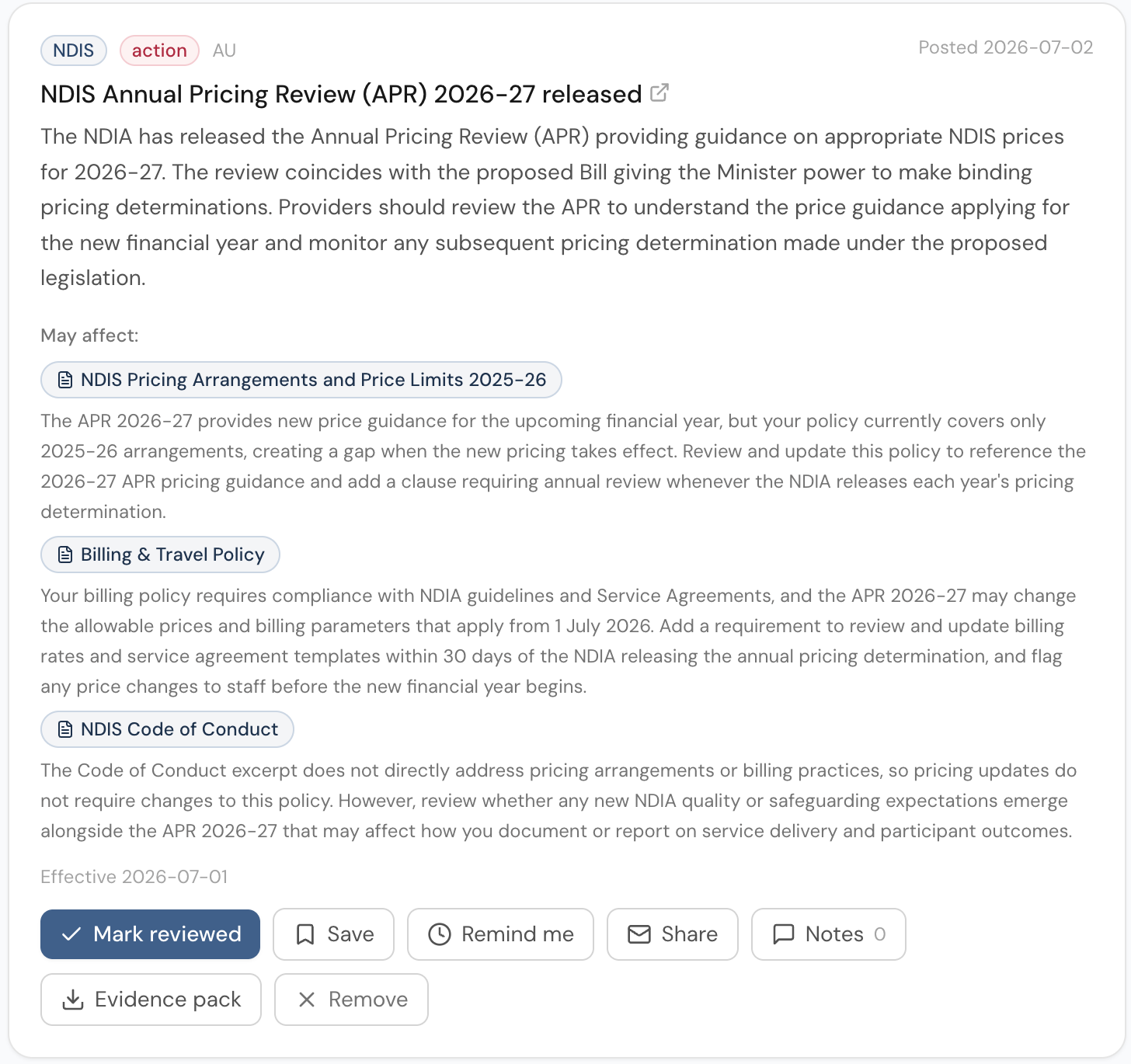
Regulatory Radar alert for the NDIS APR 2026–27 showing affected policies including pricing arrangements and billing policy, with mark reviewed and evidence pack actions.
The new prices are live. The question is whether you can prove you handled the change properly. Start a free 14-day trial at accorda.com.au and see how much lighter regulatory change feels with a system behind you.
Sources
This article is general information for Australian care and regulated businesses and isn't legal or compliance advice. Requirements differ by sector, registration and service type, and they change over time. Always check the current standards and rules that apply to your service. Last updated July 2026.