
Feature · Internal audit
Run the audit on yourself first.
Internal audit walks you through the Practice Standards question by question, in plain English, with the evidence to look for spelled out. Anything you mark non-compliant becomes a corrective action you can track to close-out, so gaps surface on your terms, not the auditor's.
14 days, every feature, no credit card.
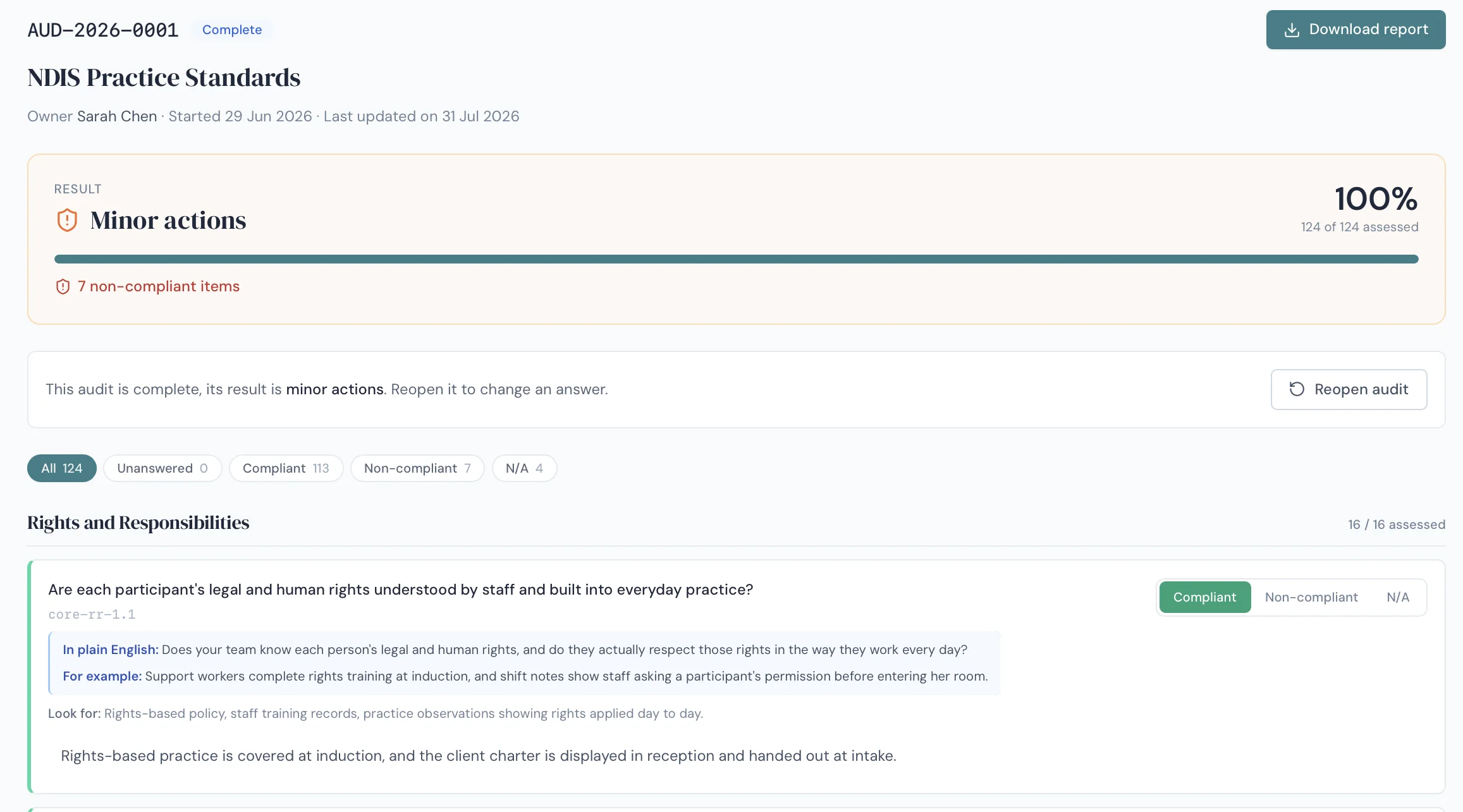
The standards, in plain English
The Practice Standards are written for auditors. Accorda restates each requirement as a question you can answer, and names the evidence an auditor would expect to see for it. You work through them at your own pace, and the result is a picture of where you stand before anyone else looks.
Findings become actions
A finding that lives in a report is a finding that gets forgotten. Anything you mark non-compliant becomes a corrective action in the same register your incidents use, with an owner and a status, tracked to closure.
- Question-by-question walkthrough with evidence prompts
- Non-compliant items become corrective actions automatically
- Completed audits stay on the record as evidence of self-assessment
Audits on a repeating schedule
Self-assessment counts for more when it happens on a rhythm rather than the month before an audit. Set an audit to repeat monthly, quarterly, six-monthly or yearly, and Accorda opens it ahead of the due date (14 days before, unless you change it), assigns it to the people or the group who do it, and reminds them. Repeats follow the calendar, so a late audit never pushes the next one back.
For management meetings and auditors, the overview report downloads as a PDF for any date range: how many audits were due, the completion rate, the on-time rate, what is overdue now and the average days late. Scheduling is switched on in Workspace settings when you are ready for it.
- Emails when an audit opens, 7 days before it is due and on the day, then weekly while it is overdue
- A Monday summary for the people who manage audits: what is due, what is overdue, what was completed
- Staff answer the audits assigned to them under My audits; signing off stays with managers and admins
- Audit timeliness in compliance analytics, the evidence pack and the management review
Your own checklists, uploaded from Excel
Audit against your own house audit, a client contract or an internal procedure, alongside the built-in checklists. Download the Excel template, fill in a row per requirement (section, an optional reference, the requirement and optional guidance) and upload it. Accorda checks the file and lists any problem rows before anything is saved. Or copy a built-in checklist and edit it to suit.
Each saved change makes a new version, and an audit always keeps the version it started with, so past audits never change underneath you. Your own checklists get everything the built-in ones do: the AI helpers, the report, scheduling, analytics and the evidence pack.
Not sure where to start?
The free Compliance Readiness Check takes about four minutes and gives you a readiness band and a breakdown across nine compliance domains. It is the short version of this, with no account needed.
Sources and references
The regulatory statements on this page rest on the official sources below. Requirements change; the regulator’s own site is the authority for your service.
Guides
Plain-English answers to the questions behind this page.
How often should you run internal audits? Building a schedule
Often enough that every standard is checked between external audits, and your riskiest areas more often than that. Here is how to build an internal audit schedule that holds up.
Read the guideWhat is a management review, and what should your board see?
A management review is a scheduled meeting where leadership looks at how quality and safety are actually performing, using the records, and decides what to change. Here is what goes in, what comes out, and what a board should see.
Read the guideWhat an NDIS audit actually looks at
An NDIS certification audit is not a document check. It is an evidence check, and most of the evidence is about people. Here is what the auditor asks for and why.
Read the guide
FAQ
Straight answers.
Is this the same as the registration audit?
No. It is your own self-assessment against the same standards, so gaps surface before the real audit. The completed internal audit is evidence that you assess yourselves.
Which standards does it cover?
The built-in checklists follow your compliance profile: the NDIS Practice Standards core module and, where you deliver them, supplementary modules such as Supported Independent Living; the strengthened Aged Care Quality Standards; the National Quality Standard for early childhood services; and work health and safety checklists for trades and for office and health settings. You can add your own checklists as well.
Can internal audits repeat automatically?
Yes. Set a schedule (monthly, quarterly, six-monthly or yearly) and each audit opens before its due date, with reminders to the people doing it. A late or unfinished audit never moves the next due date.
Can we use our own audit checklist?
Yes. Fill in the Excel template and upload it, or copy a built-in checklist and edit it. Every saved change is a new version, and audits already started keep the version they began with.
Does the AI answer the audit for us?
No. The AI helpers point to areas worth a look and quote passages from your own policies, but a person decides every answer. They read your written policies, not what happens in practice.
How do we show the board that audits are done on time?
Download the overview report for any date range: completion rate, on-time rate, overdue audits and average days late. Audit timeliness also appears in compliance analytics, the evidence pack and the management review.
Related
Start today
Walk into your next audit ready.
Try Accorda free for 14 days. Every feature, no credit card.