If you run a small care or regulated business, you already know the quiet dread of the policy folder. Incident management, medication, WHS, privacy, complaints handling, infection control — a growing pile of documents you're required to have, keep current, and prove your staff actually follow. Writing them from scratch is one of the biggest barriers for any new or growing provider, and paying a consultant thousands for a generic pack stings just as much.
So it's no surprise that a lot of owners have quietly opened a chatbot and typed "write me an NDIS incident management policy." The honest question is: can you actually do that? The short answer is yes — AI can save you a genuinely large amount of time. But there's a longer, more important answer, because a generic AI policy dropped straight into your folder is an audit risk, not a shortcut. Here's how to get the upside without the exposure.
Why AI is genuinely useful here
Let's give credit where it's due. A good AI tool can turn a blank page into a structured, readable first draft in minutes — covering the sections a policy of that type should have, in plain English, without you needing to remember the exact anatomy of a WHS policy at 9pm. For a time-poor manager, that's not a gimmick. It removes the single hardest part of the job: starting.
AI is also good at the tedious cross-checking humans skip. Policy libraries built over years, by different people, quietly drift into contradiction — one document says incidents are escalated within 24 hours, another says 48. Auditors notice. A machine reading across your whole library at once will catch those clashes far faster than you will.
Used well, AI shifts policy work from "write everything from nothing" to "review, tailor and approve." That's a much better use of your time.
Where generic AI policies go wrong
Here's the part that matters, and where the shortcut turns into a trap.
Regulators don't want documents — they want a system. A policy sitting in a folder proves almost nothing. Under the strengthened Aged Care Quality Standards, providers must maintain policies and procedures that are "current, regularly reviewed, informed by contemporary, evidence-based practice," that are understood and accessible to workers, and that workers are actually required to follow. The NDIS Practice Standards' governance and operational management requirements likewise expect documented policies and procedures that are implemented across the organisation — not just held. A shiny AI draft you never tailored, never dated, and never trained anyone on fails on every one of those counts.
Generic is the whole problem. The reason consultant policy packs get a bad name is that they arrive as templates that could belong to anyone. AI can produce exactly the same failure at speed. If your incident policy doesn't reflect your actual escalation chain, your real roles, and your sector's specific reportable-incident rules, an auditor will spot the mismatch between the paper and the practice in minutes. A policy that describes a service that isn't yours is arguably worse than no policy at all.
A policy an auditor can't tie to how your service actually runs isn't evidence you're compliant — it's evidence you're not.
Public chatbots and client information don't mix. This is the risk people forget. Australia's privacy regulator, the OAIC, recommends that organisations do not enter personal information — and especially sensitive information — into publicly available generative AI tools, because once it's in, you can't reliably control or remove it. So while a public chatbot might help you draft the shape of a policy, you should never paste real client names, incident details, or staff records into one. The same guidance stresses that AI outputs can be inaccurate and that human oversight and accuracy checks aren't optional.
AI doesn't know when the rules change. A draft written today is frozen in time. Standards, practice requirements and screening rules shift, and a policy that was fine last year can quietly fall out of step. AI won't tap you on the shoulder when that happens — someone, or something, still has to.
How to use AI for policies the right way
None of this means don't use AI. It means use it as a drafting assistant, not an autopilot. A practical way to do it:
Draft, then tailor. Treat the AI output as a first draft, not a final policy. Edit in your real roles, escalation timeframes, sector rules and service specifics so the document describes your business.
Keep personal information out of public tools. Draft the structure and wording with generic language; never paste real client, incident or staff details into a public chatbot.
Check it against the current standards. Make sure the draft actually maps to the requirements that apply to you today — not a generic idea of "good practice."
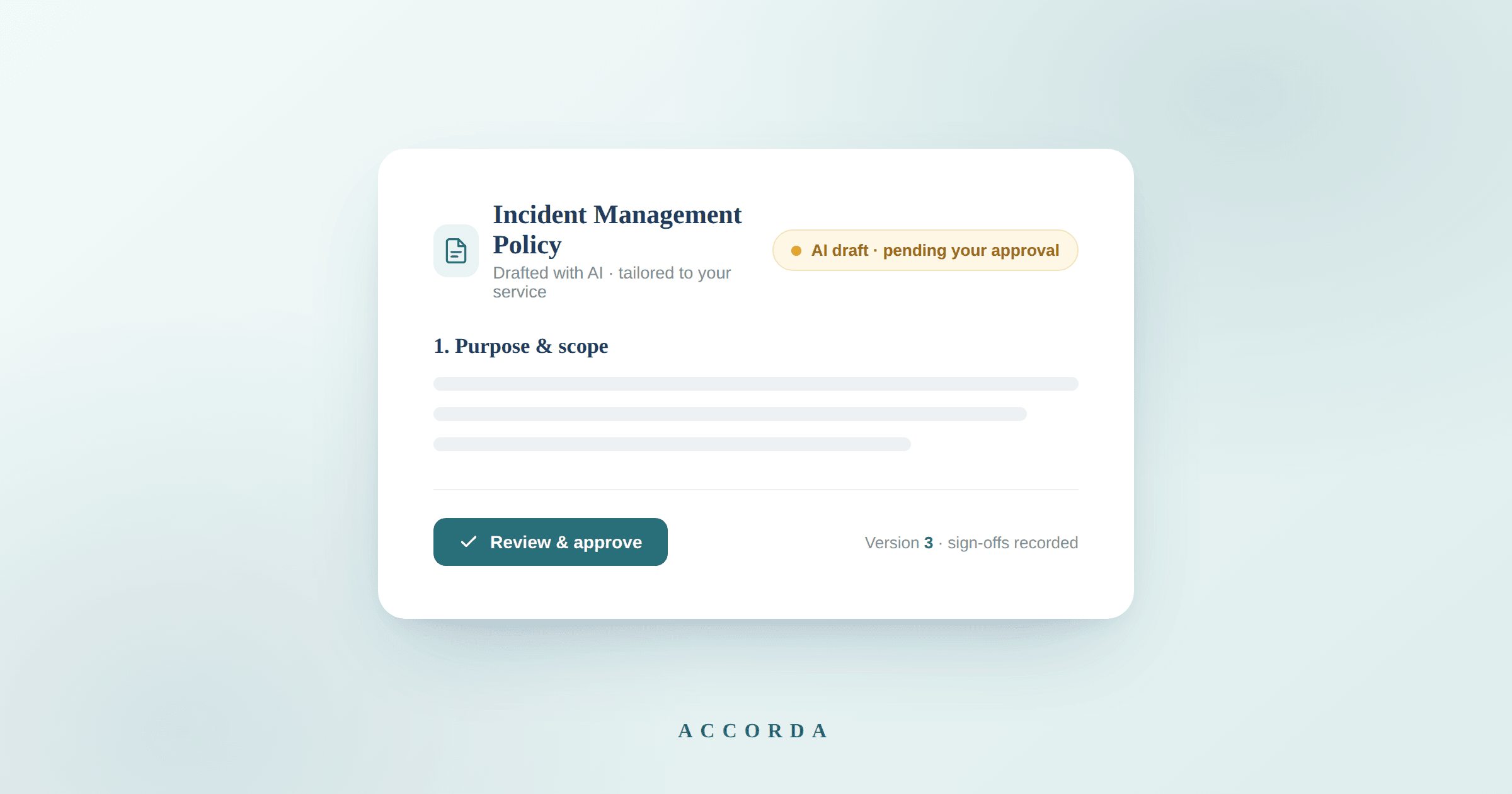
Version it, and get sign-offs. Record which version is current, and capture dated evidence that each staff member has read and acknowledged it. "We have a policy" means nothing at audit; "every staff member acknowledged version 3 on these dates" is evidence.
Keep a human in the loop. A person approves the final wording and owns the decision. AI drafts; you decide.
Plan for change. Have a way to know when a regulation shifts so you can revisit the affected policies, rather than discovering the gap during an audit.
Do those six things and AI stops being a risk and starts being the time-saver it should have been all along.
Where Accorda fits
This is exactly the workflow Accorda is built around, so it's worth being straight about it. Accorda's AI Policy Writer generates sector-specific drafts — it knows an NDIS provider needs something different from a fire-protection business — and runs its own review loop to critique and improve the draft before it reaches you. Its coherence scanner reads across your whole library and flags the contradictions hiding between policies. Then every policy is versioned, and when one changes, affected staff are prompted to re-read and re-acknowledge it, with each sign-off recorded by who, what version, and when.
Crucially, the human always approves. Accorda's design principle is simple — AI drafts, flags and suggests; people decide. It won't auto-report anything to a regulator or replace your professional judgement, and it doesn't pretend to. What it does is take the workflow above — draft, tailor, check, version, sign off, keep current — and put it in one place, so the policies you hand an auditor are a defensible system rather than a folder of documents that could belong to anyone.
Used with a bit of care, AI is one of the best things to happen to small-provider compliance in years. The trick is to let it do the drafting, and keep the judgement — and the evidence — firmly yours.
Sources
Disclaimer
Disclaimer This article is general information only, current as at July 2026, and is not legal or compliance advice. Regulatory requirements can change.